
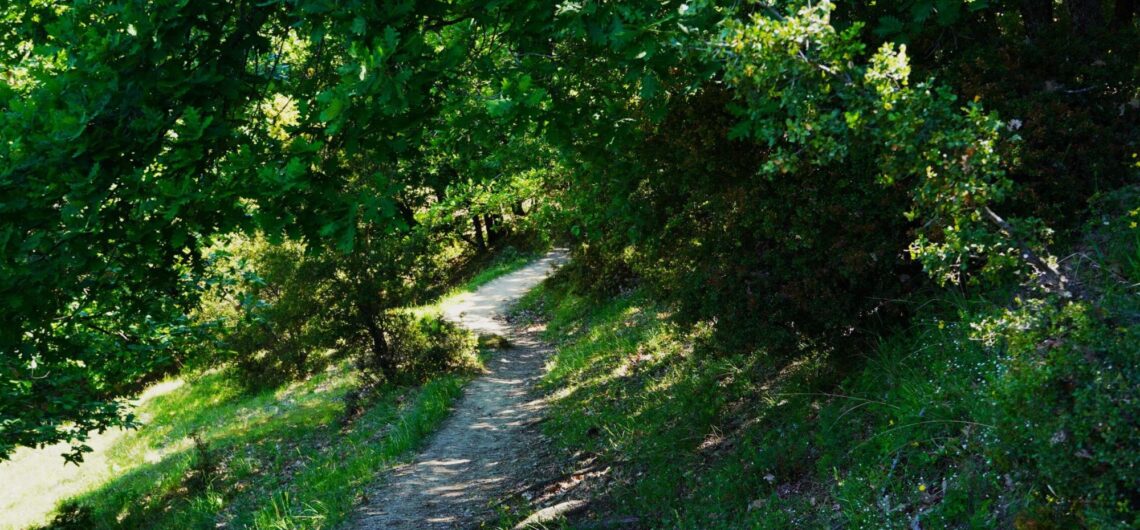
Trail management in Greece has reached a turning point. As OFYPEKA’s national trails plan runs out of deadlines and funding, the public debate inside the hiking community is opening up for good. At the recent Panhellenic Trails Meeting in Polykastro we heard the frustration of everyone who watches the country treat its trails superficially. That is why, as the Paths of Greece Social Cooperative, we are taking a position in this critical discussion.
1. Projects without trail management: a mentality that costs
Trails are not static pieces of infrastructure. On the contrary, they are living organisms. Moreover, they ask for constant care and clearing, field knowledge and an organic –as well as emotional– bond with the local community.
However, many restoration programmes stop at absorbing funds. In addition, unskilled crews work hastily and without supervision. As a result, we all know the outcome in advance:
- First, we treat trails as one more tourism product. Not as a social good of recreation, knowledge and culture.
- Second, once the funding lights go out, municipalities cannot maintain them. In other words, they lack the technical capacity, the specialised staff and the monitoring mechanisms.
- Finally, local volunteers and local organisations end up on the margins. And yet they kept the trails open for years.

2. Spatial planning and understaffed services
Poor trail management in Greece is not an isolated phenomenon. In fact, it extends wider pathologies in the way we treat public space.
- No spatial or institutional status: the National Cadastre does not recognise trails as spatial entities. At the same time, a clear spatial planning framework for land uses and protected areas is missing. Thus, encroachment, uncontrolled bulldozing of new roads and industrial interventions find an open road.
- Understaffed services: forestry departments, municipal technical services and archaeological services often sign off "ready-made" studies and contracts under pressure. And all of this simply to show spending rates. Meaningful quality control in the field, however, rarely happens.
3. From parallel monologues to institutional representation
Denouncing what goes wrong on social media is not enough. In practice, the discussion there ends in parallel monologues. We therefore need a plan, training and institutional representation.

- Training and involvement of the local community: no trail lasts over time unless local people love it and look after it. That is why municipalities must invest in training residents, in working with local groups and in permanent maintenance mechanisms.
- Volunteering and professionalism together: volunteering is the soul of the trails. It needs, however, scientific guidance and proper waymarking standards. For example, this is exactly what the Trail Guardian programme aims at.
- An institutional body: after nine years of Panhellenic Trails Meetings, the creation of the Greek Hiking Federation opens a hopeful road. Through it, the country’s hiking community –hikers, organisations, social cooperatives and local clubs– can finally speak with one voice.
Trail management in Greece is a responsibility, not a contract
The trails of Greece are our cultural and natural heritage. They are certainly not short-lived contracting objects. It is time, therefore, to protect them with knowledge, cooperation and institutional responsibility.
